 0 comments
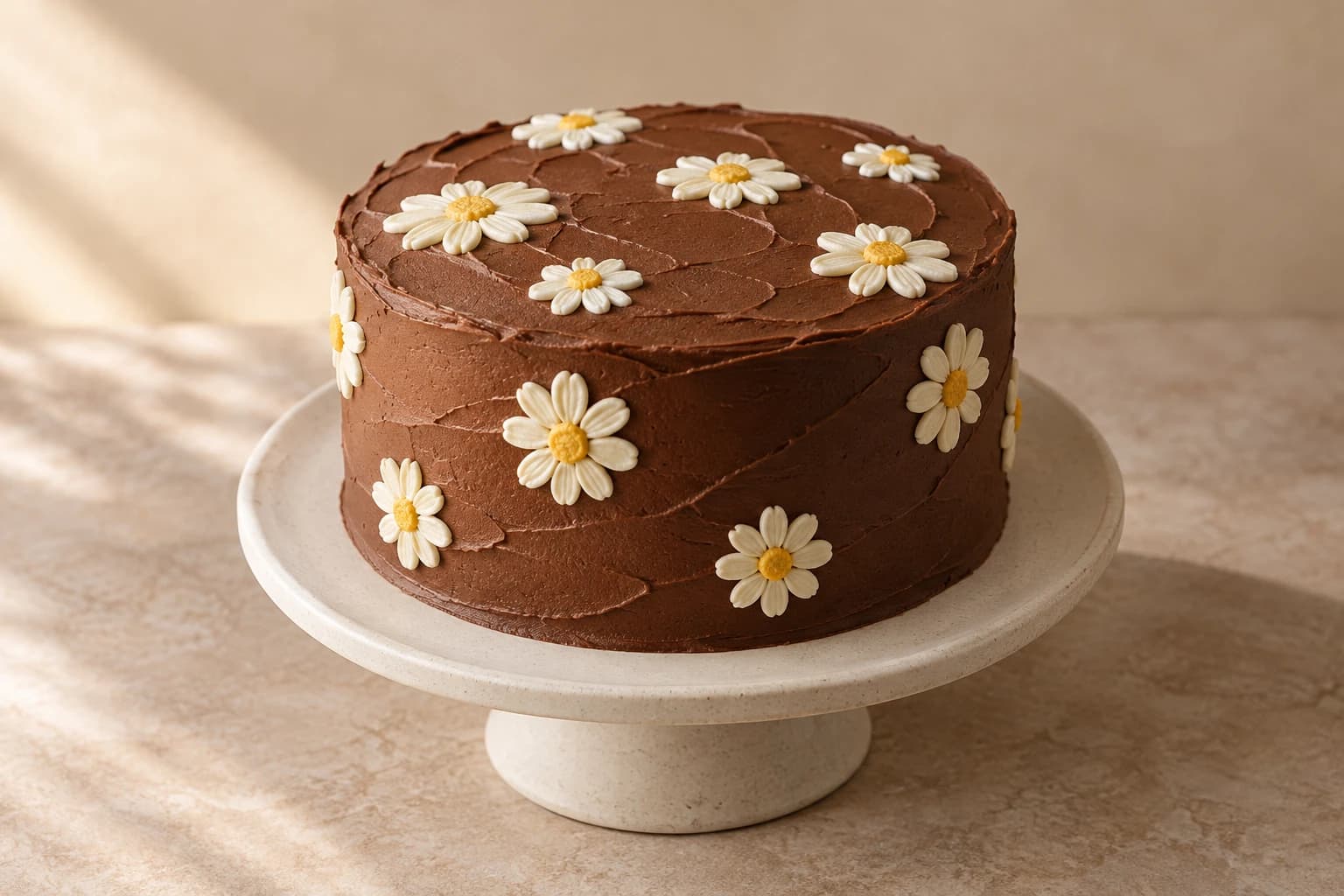
The contrast is simple: deep cocoa buttercream, white petals and tiny yellow centers. The reference appears to have a very matte finish, possibly a professional spray finish; its actual method is unknown. This original version uses smooth cocoa buttercream and piped daisies, giving a practical home finish without claiming spray velvet. This is Kumora’s original interpretation of a Pinterest design, not the pictured baker’s recipe or method. The reference remains credited to its original creator.
An original Kumora recipe inspired by the linked cake design. The linked reference is decorating inspiration, not evidence of a kitchen-tested result from this recipe. The cover is identified in its caption.
Before you start
- Two cooled 15 cm cake layers, about 3–4 cm high
- 750 g prepared deep cocoa buttercream suitable for filling and coating
- 100 g white and 20 g yellow prepared piping buttercream
- Scraper, offset spatula, 20 cm board and turntable
- Piping bags, small petal tip or 2–3 mm round tip, small round center tip
- Parchment squares and small flat spatula for transfers
Make the chocolate base and white petals distinct
Use your trusted cake and cocoa buttercream, or labeled prepared piping buttercream. Divide the 750 g cocoa portion into 140 g filling, 100 g crumb coat, 440 g final coating and 70 g repairs. Use cocoa buttercream already formulated for a deep color rather than stirring an arbitrary quantity of dry cocoa into finished vanilla icing. Extra powder can make it dry and rough.
Reserve 100 g white and 20 g yellow buttercream for approximately twelve small daisies, including spares. White petals need a frosting that holds a ridge but extrudes without great force. Set these bowls aside with clean tools so cocoa traces cannot discolor them. The cake may be vanilla or chocolate; decoration color does not establish the sponge flavor.
Pipe daisies flat on parchment
Mark 1.5–2 cm circles on the underside of parchment squares. With a small petal tip, place the wide end near the center and pipe short petals outward, returning slightly inward as pressure stops. Rotate the square and repeat seven to nine times around the center. With a round tip instead, pipe short teardrop strokes from the outer end toward the middle.
Add a yellow dot to hide the joins. Keep each daisy shallow: thick heavy flowers are more likely to slide on the cake side. Chill or freeze on a flat tray until firm enough to lift without bending. Keep the flowers on parchment until placement; do not hold them in warm fingers. Make extra flowers so cracks do not need to be concealed.
Coat smoothly without claiming velvet spray
Fill and stack the cake, crumb-coat and chill 20–30 minutes until firm. Apply a continuous cocoa coat and scrape gently, clearing the blade after each turn. Fill pinholes with a small smear of matching frosting and scrape once more. A clean scraper warmed in water and then completely dried can smooth a few marks, but avoid repeated hot passes that melt the coat.
The expected surface is smooth buttercream with subtle spatula texture, not a uniform flocked velvet. Dusting ordinary cocoa powder over it does not recreate a professional cocoa-butter spray finish and can leave a dry, streaky surface. This guide needs no spray gun, aerosol or freezer-finish method. Chill the final coat until it can support a transferred flower.
Scatter flowers with a restrained layout
Place three or four daisies loosely across the top, then four or five on the visible sides at varied heights. Keep open brown space between flowers, and do not crowd a row around the board. Add a tiny dot of fresh cocoa frosting at each position to anchor a cold flower.
Slide a small flat spatula under the chilled daisy, peel away its parchment and set it against the attachment dot. For side flowers, support the lower edge for a moment, then remove the spatula gently. Work one flower at a time while the others remain cold. No toothpicks or hidden wires are needed for these small shallow decorations.
Repair color contamination and sliding flowers
If a white petal picks up cocoa, replace the flower using a clean tool; painting white frosting over a brown smear often makes the flower bulky. If the daisy slides, chill the cake and reduce the attachment dab. A dry, firm coat and a light flower are more effective than a large adhesive mound.
A cracked flower can sometimes be used on top with a small repair dot beneath it, but use intact spares on vertical sides. If the chocolate coating tears during placement, lift the flower, patch the hole and chill before trying again. All petals and centers are edible frosting; these daisies do not establish the safety of any real daisy species.
Presentation, transport and storage
Place the finished dessert on a clean food-safe board or plate and use a box with clearance above and beside every decoration. Chill before transport, support the board from underneath and keep it level on a nonslip surface in a cool vehicle. Avoid adding paper cards, fabric, wire or florist materials to the edible surface. The concept hero illustrates the intended look; it is not a photograph of a tested result.
Refrigerate covered at 4°C or colder. For best quality, plan to serve within 3 days, following any shorter limit on your cake, filling, frosting or decoration packaging. This is a conservative planning window, not a validated shelf-life claim. Keep leftovers covered and refrigerate promptly. Soften only the cake portions you will serve briefly in a cool room.
Keep perishable desserts out of refrigeration for no more than two hours in total, reduced to one hour above 32°C / 90°F; decorating, transport and display time count together. Use a clean knife and wipe it between portions. This temperature and time guidance follows the FDA’s safe storage advice (https://www.fda.gov/consumers/consumer-updates/are-you-storing-food-safely).
The little details
- Keep separate tools for cocoa and white buttercream.
- Small flat flowers adhere more reliably than tall sculpted blooms.
- Accept a soft buttercream sheen; it is different from a spray finish.
Your questions, answered
Can I dust cocoa on top for a velvet effect?
A light dusting changes the taste and surface, but it does not produce cocoa-butter spray velvet. The smooth buttercream adaptation is the intended finish here.
Can I pipe the daisies straight onto the cake?
Top flowers are possible, but working flat on parchment makes consistent petals easier. Side piping requires a different hand position; transferred chilled flowers are more manageable.
Why do the petals disappear into each other?
The icing may be too warm or the flower too small for the tip. Cool it briefly, stir gently and practice a larger circle before adding more petals.
Made it? Let’s talk.
Share how your bake went, ask a question, or pass on a helpful tip. There’s a seat for you here.
A kind kitchen is a happy kitchen. Our community guidelines →
No comments yet. Be the first to say hello.