 0 comments
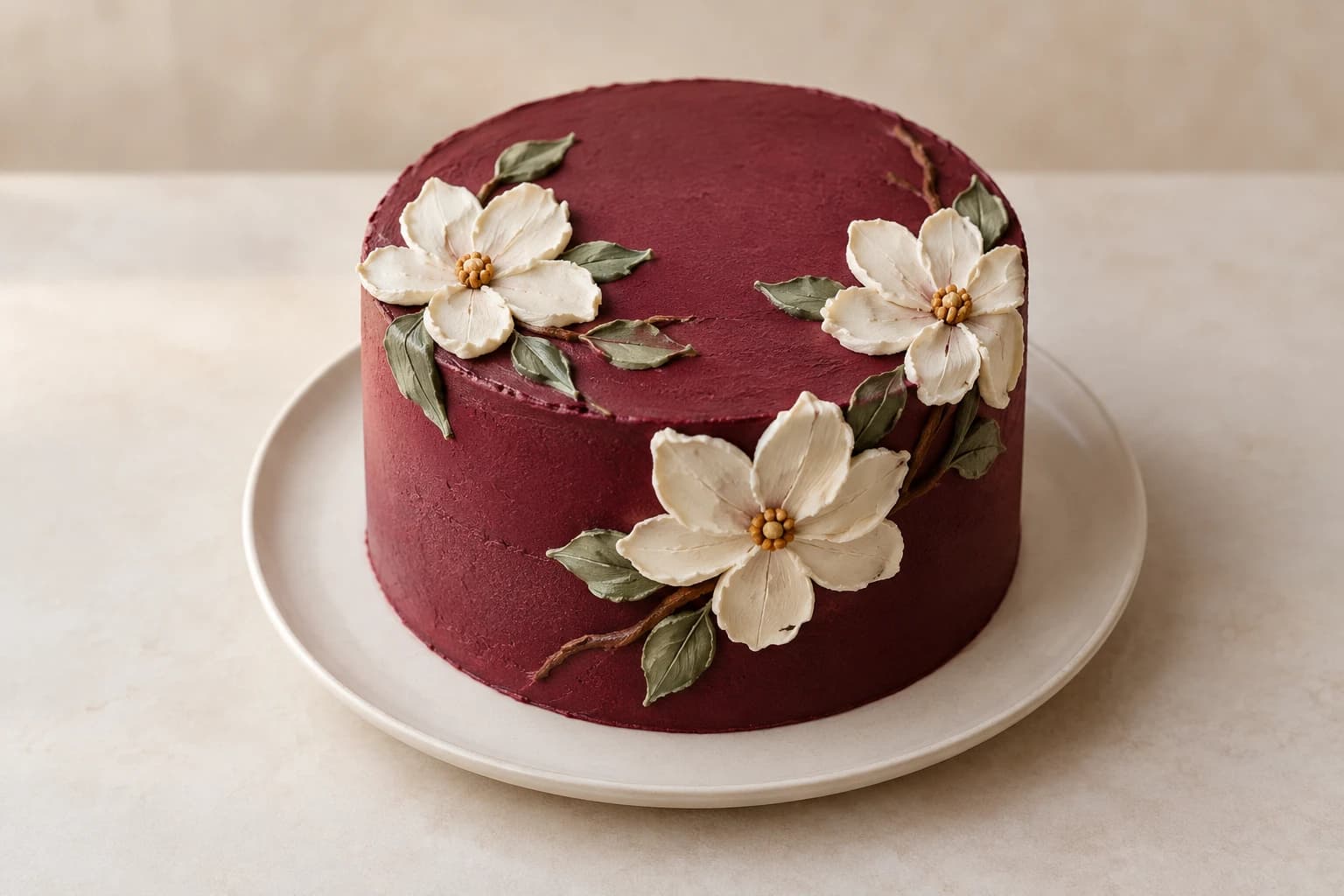
Ivory magnolia-like petals and fine branches stand out against wine-burgundy buttercream. This original Kumora decorating guide starts with baked, fully cooled cake layers and shows how to build the design with a palette knife. The reference carries a Madeleine’s creator mark; this is our interpretation, not that baker’s recipe. The plan is not kitchen-tested, and the cover is an AI-generated concept.
An original Kumora recipe inspired by the linked cake design. The linked reference is decorating inspiration, not evidence of a kitchen-tested result from this recipe. The cover is identified in its caption.
Before you start
- Digital scale, separate color bowls and flexible spatulas
- Rigid food-contact cake board at least 20 cm across, turntable and tall cake box
- Offset spatula, straight cake scraper and food-safe parchment for practice
- Piping bags, refrigerator and a clean dedicated food-use brush
- Three cooled 15 cm / 6-inch cake layers, stacked to about 9 cm including filling
- Small rounded food-use palette knife with a blade approximately 1–1.5 cm wide
- Fine round piping tip with a 1–2 mm opening
- Prepared egg-free piping buttercream and food-grade burgundy, green, brown and ochre gel colors
Plan the cake and a loose flowering branch
Use three level 15 cm layers, each about 2.5 cm thick, with two thin buttercream fillings. A finished height near 9 cm gives room for a side flower without requiring an unusually tall stack. A soft or very moist cake needs the handling guidance of its own recipe. Avoid a thick loose cream filling under the weight of the layers.
Sketch three flowers, each about 4 cm across: two near opposite parts of the top rim and one on the upper front side. Keep petals on the cake surface rather than projecting over the edge. Join them with short branches and leave the top center open for a short birthday message. The sketch sets your arrangement; it does not trace the creator’s photograph.
Measure and color the frosting
Allow 1,000 g prepared egg-free vanilla piping buttercream: 730 g for burgundy filling and coating, 180 g ivory for petals and optional lettering, 55 g muted green for leaves, 25 g brown for stems and 10 g pale ochre for centers. These are planning allowances including practice and bag residue, not a frosting formula. Have extra base frosting available if your layers are taller or your coating is thick.
Choose a buttercream that spreads smoothly and holds a small raised stroke; pourable icing and loose whipped cream are unsuitable. Color the burgundy portion together using concentrated food-grade gel within the maker’s instructions. Add color gradually, rest it and check a thin smear in daylight. A wine shade is enough; excessive gel can affect taste. Keep the ivory clean by using separate spatulas. Tint the leaves green with a trace of brown for a muted finish.
Fill and establish a firm burgundy background
Anchor the first layer to the board with a small dab. Use about 160 g burgundy frosting across the two fillings, spreading each evenly and just short of the edge. Stack level. Apply about 140 g in a thin crumb coat, then refrigerate for roughly 20–30 minutes until the surface is firm. Smooth the final coat with about 380 g, retaining 50 g for repairs.
Keep the scraper upright and turn the cake rather than sawing the scraper around it. Pull the top lip inward with a clean spatula. Chill again until a light touch leaves no frosting on your finger. If condensation appears, let it dry in a cool room before decorating. Firm base frosting and pliable petal frosting are the useful contrast; two soft layers will mix colors.
Practice broad ivory petals before making a flower
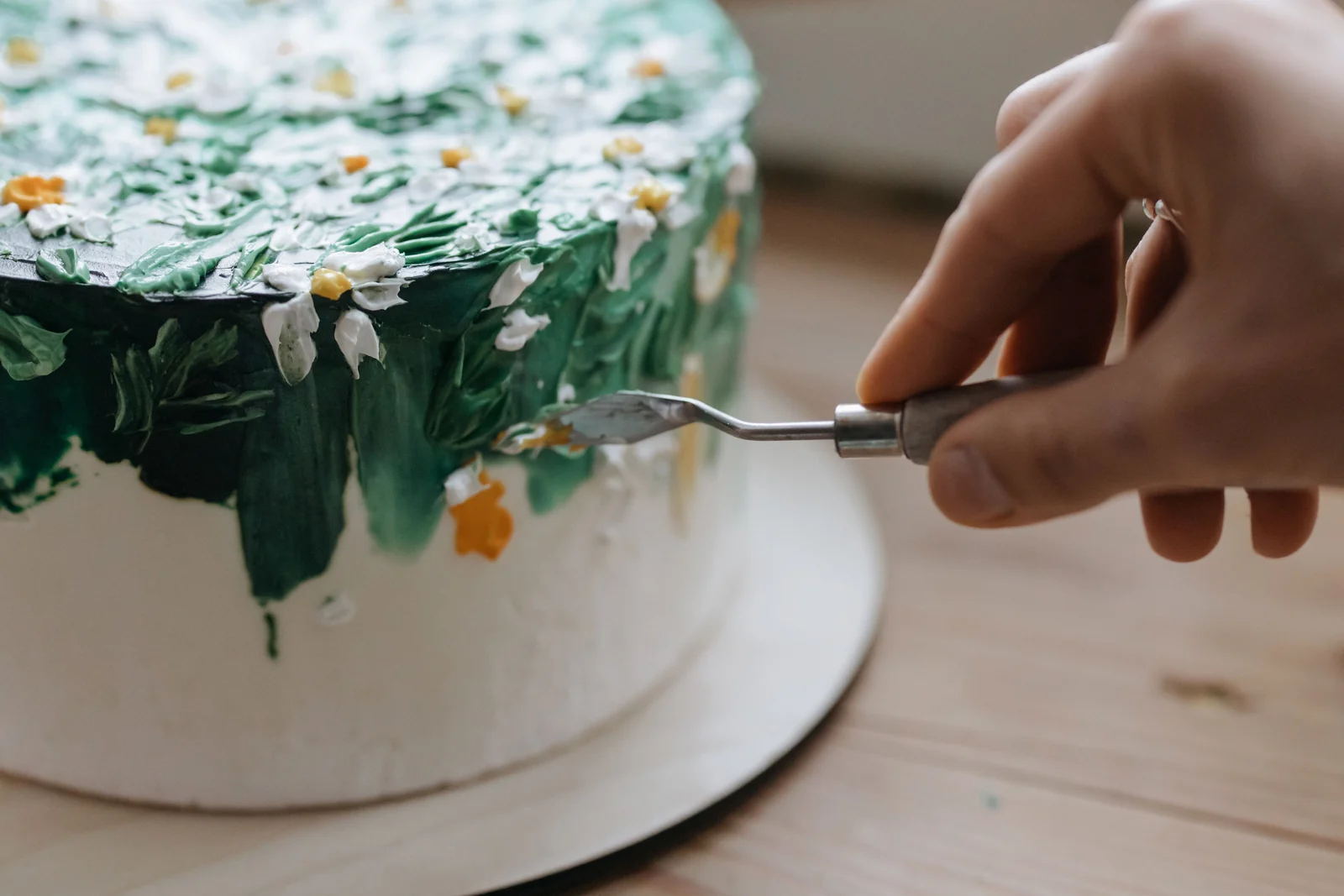
Spread a thin burgundy patch on parchment fixed to a flat board and chill it. Mark a flower center and five or six petal directions. Load a small pea-sized dab of ivory frosting on the underside of the rounded knife tip. Place the loaded tip at a petal’s outer end, press gently to form a broad oval, then draw about 1.5 cm toward the center while reducing pressure. Lift near the center. The outer end stays broad and raised while the inner end tapers.
Wipe the blade between strokes, especially if it picks up burgundy. Make three outer petals first, then fill the gaps with two or three overlapping petals. Keep relief around 2–3 mm rather than piling up a heavy flower. Vary the angle slightly so the blossom feels organic. These are magnolia-like decorative shapes, not a botanical model. Practice on a vertical chilled patch too; the blade should approach nearly parallel to the cake side.
Build stems, leaves and blossoms in order
Mark the three centers very lightly with a clean tool. With the fine round tip, pipe thin brown stems along the surface, working from the branch base toward the flower positions. Add two or three shorter branches. Keep the tip close so the frosting adheres rather than hanging unsupported. Stop pressure before lifting the bag.
Make green leaves with the same press-and-draw motion as a petal, but use smaller dabs and a longer tapered stroke. Place most leaves beside branches and keep future flower centers clear. Clean the knife completely before returning to ivory. Apply each flower’s outer petals and then its inner overlaps. Add a few tiny ochre dots in the center, keeping them low. Pause to chill if the burgundy background softens.
Add a message and repair color smears
For a birthday version, reserve about 20 g of the ivory portion and practice a short greeting at the actual size on parchment. Use the fine tip in the open top center; stop squeezing between letters. The hero deliberately has no lettering. Do not copy the reference watermark or creator signature as decoration.
If a petal pulls up the base, stop and chill before continuing. If ivory smears pink, clean the blade and replace that petal using fresh frosting. For a bulky flower, firm it first, lift away the local decoration carefully with an offset spatula, patch the burgundy and remake it smaller. Ragged strokes usually need slightly softer petal frosting; slumping strokes need cooling. Adjust temperature before adding liquid.
Present, transport and store
Set the cake on a simple pale plate or its rigid board so the burgundy outline remains visible. Use soft side light to show the raised petals. Check box clearance, chill until stable and transport level on a nonslip surface. Keep the box away from direct sunlight and warm vehicle air.
For quality, decorate within 1–2 days of serving and store covered without touching the petals. Follow the shortest storage limit of your cake, filling and frosting. Keep refrigerated at 4°C or colder; for perishable components, limit total time out to two hours, or one hour above 32°C. See FDA cold-storage guidance (https://www.fda.gov/food/buy-store-serve-safe-food/refrigerator-thermometers-cold-facts-about-food-safety). Allow only the portions needed to soften briefly before serving. Slice between flowers with a clean knife and refrigerate leftovers promptly.
Reference and interpretation
Design inspiration: https://www.pinterest.com/pin/1095852521860492538/ . The quantities, flower arrangement and decorating sequence here are Kumora’s original proposed approach. The cover was generated independently and does not reproduce the creator’s photograph or watermark.
The little details
- Practice a complete flower on a chilled burgundy patch before touching the cake.
- Keep an ivory repair portion clean; never return a stained knife to that bowl.
- Thin surface stems are easier to transport than raised free-standing branches.
- Do the side blossom before the optional top message so your hand has room.
Your questions, answered
Can I use actual magnolia flowers?
This guide uses edible frosting for the flowers and leaves. Do not substitute florist blooms or unidentified garden plants. Their identity, treatments and suitability for food contact cannot be established from a photograph.
Do I need a special painting buttercream?
Use a prepared piping buttercream that spreads without tearing and holds a raised petal. Practice with your own frosting; stiffness and temperature vary. This guide gives measured allowances rather than a new buttercream recipe.
Can I make this on a lower cake?
Yes. Keep the same top layout and make the side flower smaller. A shorter cake needs less coating but the petal allowance still provides useful practice frosting. Do not crowd all three flowers into a smaller top.
Made it? Let’s talk.
Share how your bake went, ask a question, or pass on a helpful tip. There’s a seat for you here.
A kind kitchen is a happy kitchen. Our community guidelines →
No comments yet. Be the first to say hello.