 0 comments
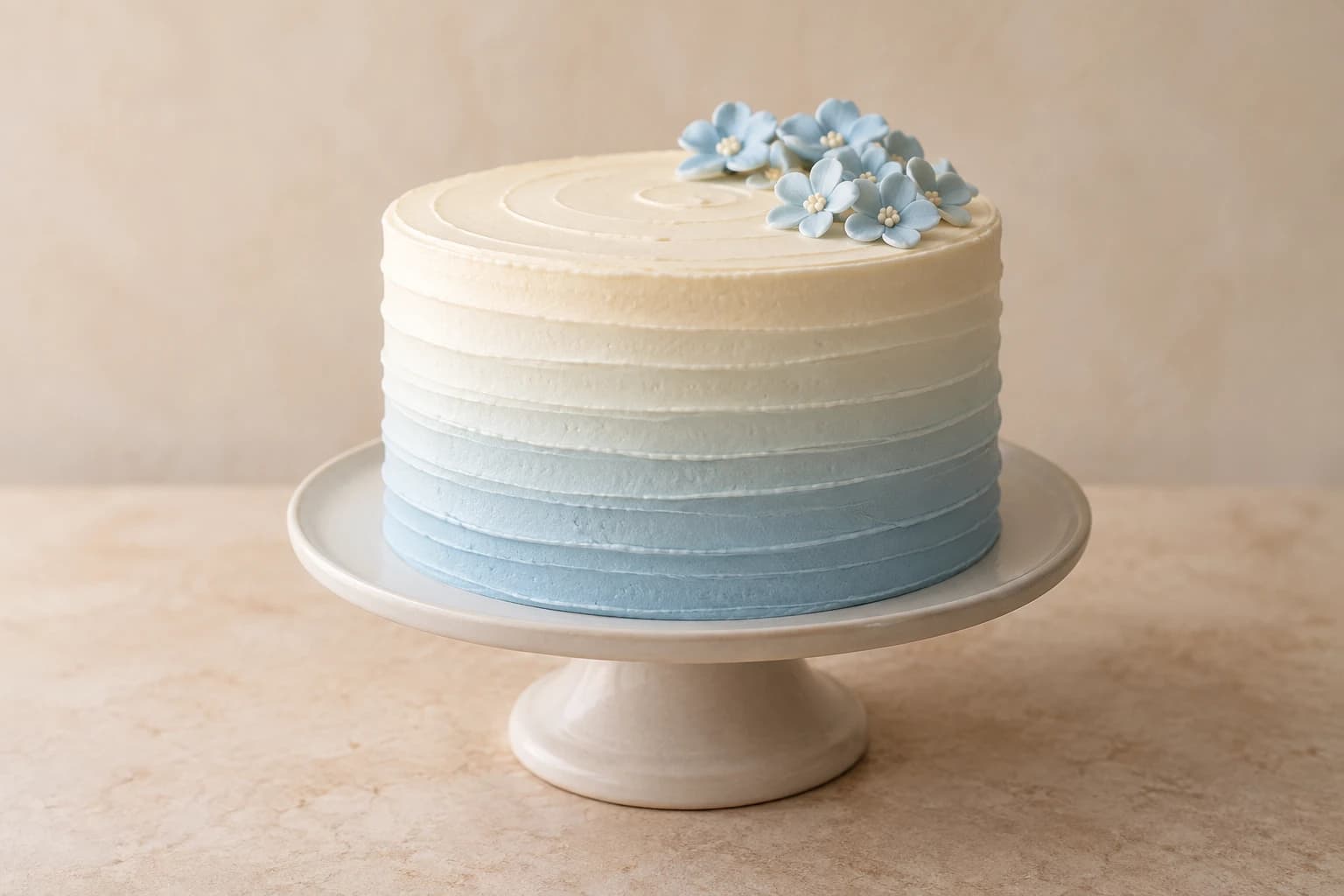
This cake shifts from powder blue near the board to ivory at the top, with shallow horizontal spatula bands softening the transition. A small group of five-petal edible flowers finishes the top. The guide begins with cooled cake layers and uses ordinary piping buttercream rather than unidentified fresh flower stems. This is Kumora’s original interpretation of a Pinterest design, not the pictured baker’s recipe or method. The reference remains credited to its original creator.
An original Kumora recipe inspired by the linked cake design. The linked reference is decorating inspiration, not evidence of a kitchen-tested result from this recipe. The cover is identified in its caption.
Before you start
- Two cooled 15 cm cake layers, about 4 cm high
- 850 g prepared ivory piping buttercream; food-grade blue gel
- Turntable, 20 cm board, scraper and small offset spatula
- Scale, four bowls, piping bags and small petal tip
- Parchment squares, optional flower nail and small round tip
Divide frosting for a controlled gradient
Set aside 150 g ivory for filling, 100 g for crumb coating and 40 g for repairs and flower centers. Divide the remaining 560 g into 170 g ivory for the top and highest band, 170 g very pale blue for the middle, 170 g powder blue for the bottom and 50 g pale blue for flowers. These quantities include some bag and tool residue; a taller cake needs more coating.
Add blue gel with the tip of a clean skewer and mix each bowl thoroughly. Compare small swatches together before coating. Aim for a gentle progression, not an electric blue stripe. Use concentrated food-grade color according to its label, rather than liquid color that loosens the frosting. Keep enough of each shade for a small repair.
Stack and map the bands
Fill the two level layers with the reserved 150 g ivory, crumb-coat and refrigerate 20–30 minutes until firm. Lightly mark the side into three roughly equal height zones. For a cake about 9 cm tall, each side zone is near 3 cm. Smooth a portion of the ivory coating over the top before working on the sides.
Apply powder blue around the lowest zone, very pale blue around the middle and ivory around the highest. Match the coating thickness in all three zones, around 3 mm. Pipe broad horizontal ropes or spread small patches with the spatula; either works as long as there are no unfilled gaps beneath the gradient.
Blend once, then make horizontal texture
Hold a straight scraper upright against the soft coating and turn the board slowly. Make one full pass to level the colors. Clean the scraper after each pass; repeatedly carrying blue frosting upward darkens the ivory top. Patch gaps with the correct local shade and make one more gentle pass. Keep a faint transition line rather than chasing perfect airbrushed blending.
For the texture, press the rounded tip of a small offset spatula lightly into the lowest band. Rotate the turntable once to make a shallow horizontal track. Lift, wipe and repeat a little higher, overlapping the tracks slightly. Move upward in separate rings, using less pressure near the top. This method produces horizontal bands without a steep spiral line. Stop if the blade begins exposing the crumb coat.
Pipe and place five-petal blossoms
On parchment, pipe five short pale blue petals around a small center, using a petal tip with its wide edge inward. Make each flower about 2 cm across and add an ivory dot. Prepare eight blossoms and choose five or six after chilling until firm. Very thin petals are fragile; modest thickness is easier to transfer.
Attach the blossoms to the rear third of the chilled cake top with tiny frosting dabs. Overlap only a few edges, keeping the group low and loose. Leave the front and center open. The original adaptation contains no fresh stems, floral wire or florist material. Commercial edible sugar flowers can replace piped flowers if their label and storage instructions suit the cake.
Fix streaks and uneven bands
A dark streak in the ivory band is easiest to lift while chilled, then patch with a little reserved ivory. Clean the tool before leveling the repair. If horizontal grooves become deep, spread a thin patch of the local color and re-texture that ring with lighter pressure. Avoid scraping the entire cake to repair one mark.
If flowers slide, the base is warm or their attachment dab is too large. Chill both cake and flowers, then use a small dab and keep the cluster flat. If petals break during transfer, choose the extras rather than hiding fractures beneath more decorations. Display on a simple white plate to let the gentle gradient remain the focal point.
Presentation, transport and storage
Place the finished dessert on a clean food-safe board or plate and use a box with clearance above and beside every decoration. Chill before transport, support the board from underneath and keep it level on a nonslip surface in a cool vehicle. Avoid adding paper cards, fabric, wire or florist materials to the edible surface. The concept hero illustrates the intended look; it is not a photograph of a tested result.
Refrigerate covered at 4°C or colder. For best quality, plan to serve within 3 days, following any shorter limit on your cake, filling, frosting or decoration packaging. This is a conservative planning window, not a validated shelf-life claim. Keep leftovers covered and refrigerate promptly. Soften only the cake portions you will serve briefly in a cool room.
Keep perishable desserts out of refrigeration for no more than two hours in total, reduced to one hour above 32°C / 90°F; decorating, transport and display time count together. Use a clean knife and wipe it between portions. This temperature and time guidance follows the FDA’s safe storage advice (https://www.fda.gov/consumers/consumer-updates/are-you-storing-food-safely).
The little details
- Compare the three shades on white parchment before frosting.
- Texture each ring with a clean blade so the ivory stays pale.
- A softly visible color boundary is easier to achieve than a perfectly sprayed fade.
Your questions, answered
Can I use two colors rather than three?
Yes, but the join is more obvious. Keep powder blue low and ivory high, then blend only the meeting edge with a clean scraper.
Do I need a turntable?
It makes uninterrupted horizontal rings much easier. Without one, rotate the board in short steps and accept softly joined tracks; keep your hand off the cake.
Are these fresh blue flowers?
No. This original version uses edible buttercream blossoms or labeled edible sugar flowers; the reference does not establish the safety of any real plant.
Made it? Let’s talk.
Share how your bake went, ask a question, or pass on a helpful tip. There’s a seat for you here.
A kind kitchen is a happy kitchen. Our community guidelines →
No comments yet. Be the first to say hello.