 0 comments
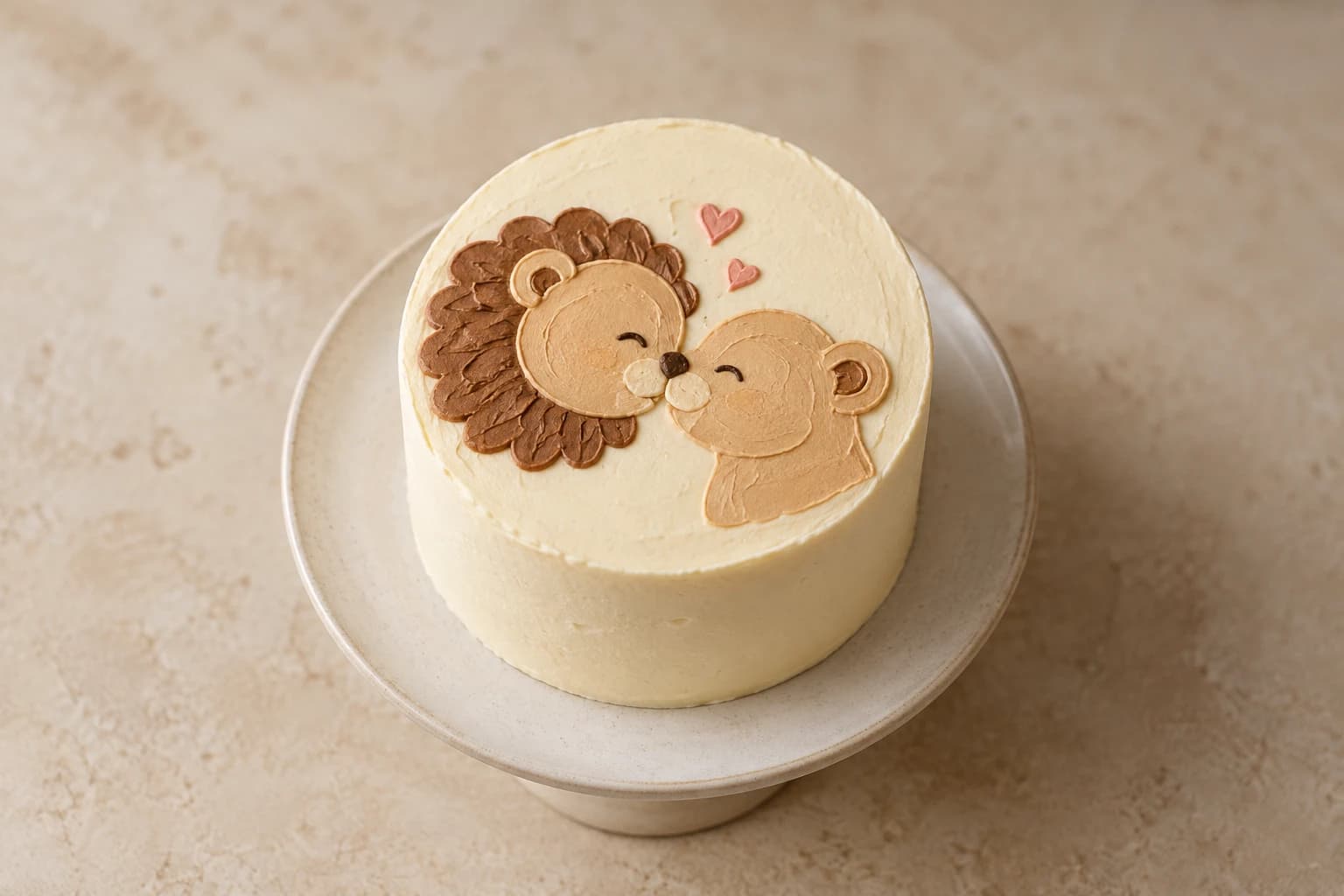
A small cake can carry a warm anniversary illustration without copying familiar movie characters. This design uses an original lion and lioness touching noses, simple tan faces, a rounded mane and two small hearts. The parchment transfer keeps the drawing flat and makes it easier to work at full scale before decorating. This is Kumora’s original interpretation of a Pinterest design, not the pictured baker’s recipe or method. The reference remains credited to its original creator.
An original Kumora recipe inspired by the linked cake design. The linked reference is decorating inspiration, not evidence of a kitchen-tested result from this recipe. The cover is identified in its caption.
Before you start
- Two cooled 10 cm / 4-inch cake layers, about 2 cm high
- 350 g prepared ivory piping buttercream
- Food-grade tan, brown and pink gel colors
- Food-safe parchment, plain paper and pencil for an original sketch
- Piping bags, 1–2 mm round tips or neatly cut bag openings
- Small flat board that fits the freezer; offset spatula; bento box and food-safe cake board
Sketch an original pair at cake size
Draw a 10 cm paper circle and sketch the lion couple inside a 7 cm-wide central area. Use rounded tan faces, short muzzles and tiny dark eyes. Give one lion a modest scalloped brown mane; the other can have a lighter rounded head with small ears. Let their noses almost touch. Avoid copied character profiles, distinctive movie styling and the reference lettering.
If you want an anniversary message, keep it to initials or two short words along the lower rim and reserve that space now. Lettering will be piped directly after the transfer, so it will read normally. Put a longer message on a separate card. The concept hero intentionally contains no text.
Allocate frosting and build the bento base
Divide 350 g prepared piping buttercream into 50 g for filling, 40 g crumb coat, 170 g final ivory coating, 40 g tan transfer shapes, 25 g brown mane, 10 g dark-brown details, 5 g pink hearts and 10 g ivory backing or repairs. A small amount remains in bags, so the drawing must stay compact. Use a frosting that firms when chilled; a soft whipped topping is unsuitable for a removable transfer.
Fill the cake, align the layers, crumb-coat and chill 15–20 minutes. Add the final ivory coat and chill again until firm. Test the board and box fit now: the lid must not press against the top illustration. Keep the parchment drawing separate from the edible cake; pencil marks stay on paper beneath the food-contact parchment.
Build the transfer in reverse order
Tape the original drawing beneath clean parchment on a flat board. Remember that flipping the transfer reverses the drawing; mirror the paper sketch first if the direction matters. Do not include lettering in the transfer. Pipe tiny dark eyes, noses and short mouth lines first, followed by any minimal outline. Details that should be visible on the finished top must touch the parchment first.
Briefly chill these fine lines until firm, then fill the tan face areas and brown mane, keeping the tip close so the shapes have no gaps. Pipe gently over the back of the details without dragging them. Fill the two hearts in pink. Use a clean tool to level the rear surface, then cover the whole connected lion shape with a very thin ivory backing to strengthen it. Keep total thickness around 3–4 mm.
Chill, flip and release carefully
Freeze the flat transfer until fully firm, checking rather than relying on a fixed time; 20–40 minutes is a starting estimate for a small butter-based transfer. Test release with a spare practice patch of the same frosting. Some commercial frostings stay tacky even when frozen, so that test prevents a surprise on the cake.
Place a small smear of ivory frosting on the chilled cake where the drawing will sit. With parchment facing upward, invert the firm transfer onto the cake. Press very lightly through the paper and peel it back slowly at a low angle. Keep the transfer cold during the move. Position separate hearts the same way or pipe them directly afterward.
Finish the expression and optional message
Inspect both faces from directly above. Add only missing tiny details with a fine tip rather than outlining every edge heavily. For optional wording, practice the exact initials or short message on parchment, then pipe in the reserved area with brown buttercream. Stop squeezing before lifting at the end of each stroke.
If a nose or eye stays on the parchment, pipe that detail back into its original position. If the whole shape sticks or bends, stop, re-freeze and try the practice patch again. If it still fails, use the original sketch to pipe simple shapes directly onto the firm cake, back to front: mane, faces, muzzles, then eyes and noses. The fallback remains your own animal drawing.
Presentation, transport and storage
Place the finished dessert on a clean food-safe board or plate and use a box with clearance above and beside every decoration. Chill before transport, support the board from underneath and keep it level on a nonslip surface in a cool vehicle. Avoid adding paper cards, fabric, wire or florist materials to the edible surface. The concept hero illustrates the intended look; it is not a photograph of a tested result.
Refrigerate covered at 4°C or colder. For best quality, plan to serve within 3 days, following any shorter limit on your cake, filling, frosting or decoration packaging. This is a conservative planning window, not a validated shelf-life claim. Keep leftovers covered and refrigerate promptly. Soften only the cake portions you will serve briefly in a cool room.
Keep perishable desserts out of refrigeration for no more than two hours in total, reduced to one hour above 32°C / 90°F; decorating, transport and display time count together. Use a clean knife and wipe it between portions. This temperature and time guidance follows the FDA’s safe storage advice (https://www.fda.gov/consumers/consumer-updates/are-you-storing-food-safely).
The little details
- Make a small test transfer before committing the full illustration.
- Keep eyes and noses tiny; a thick outline can overwhelm a bento cake.
- Write messages directly after transferring so they are not reversed.
Your questions, answered
Can I reproduce the movie lions in the reference?
This guide and hero use an original lion couple instead. Create your own simplified animal drawing rather than copying characters or the exact source illustration.
Will every buttercream release from parchment?
No. Texture and fat composition matter. Choose a frosting that firms when cold and test a small patch; use direct piping if it remains sticky.
Can I use a regular paper drawing on the cake?
No. The sketch stays beneath food-safe parchment during preparation and never touches the frosting. Remove the parchment completely after transfer.
Made it? Let’s talk.
Share how your bake went, ask a question, or pass on a helpful tip. There’s a seat for you here.
A kind kitchen is a happy kitchen. Our community guidelines →
No comments yet. Be the first to say hello.